She used to study to escape. Now she stares out the window and doesn’t even press play.
We all know her: elbows on desk, oversized headphones, pen in hand, cat nearby, window open. She’s the lo-fi girl ~ the unofficial face of an entire genre. She’s been with us through all-nighters, rainy days, breakups, and background blur. She’s a meme, a mood, and a marketing machine.
But here’s the thing no one wants to say: The lo-fi girl doesn’t represent lo-fi anymore.
She’s stuck. Frozen in a loop. Meanwhile, the music she’s supposedly listening to has changed. The audience has changed. The culture has changed. Lo-fi grew up, got emotional, got layered, got personal. But she didn’t. And honestly? She looks a little… sad.
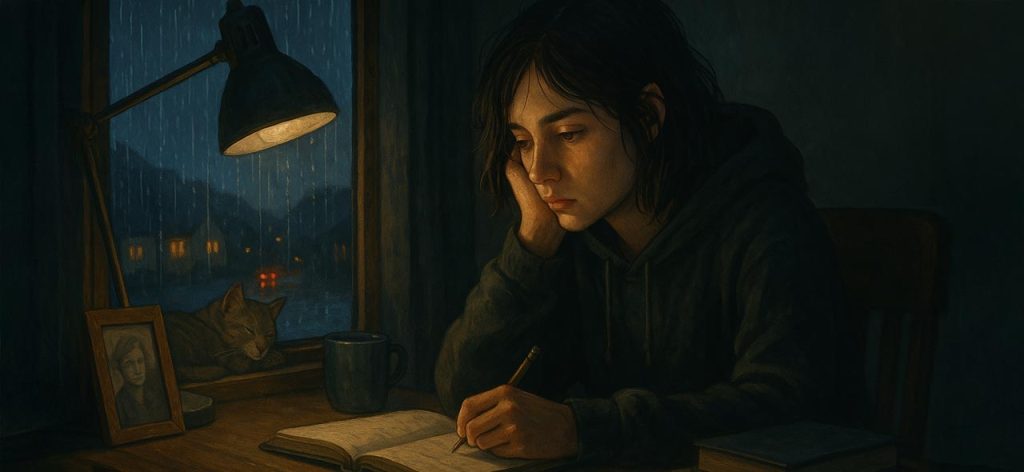
Stuck in a loop that no longer fits
What began as a symbol of comfort and focus has calcified into a nostalgia trap. She’s still there, scribbling endlessly into that notebook. But while she repeats the same movement, we’ve moved on. Lo-fi music today isn’t just “beats to relax/study to.” It’s a vessel for grief, heartbreak, fatherhood, existential dread, and soft hope. The best of today’s lo-fi is raw, stripped back, full of field recordings, late-night regret, and personal meaning. It’s not background anymore. It’s foreground for the emotionally fluent. But no one told the lo-fi girl. She’s still taking notes like finals are next week, like her biggest crisis is a coffee spill. And that’s not where this genre lives anymore.
The genre grew deeper ~ she didn’t
If lo-fi was once about lo-fi sound, now it’s more about lo-fi feeling. And that feeling isn’t always chill. Sometimes it’s heavy. Sometimes it’s tangled. Sometimes it’s straight-up unbearable. Artists are titling songs like:
- “I don’t talk to anyone anymore”
- “Wish you called”
- “For mom, who never heard this”
This isn’t study music. This is memory music. It’s diary-core. Lo-fi evolved into something emotionally mature ~ and emotionally messy. And we’re still showcasing it with a looping anime girl in a green sweater pretending nothing’s changed? It feels dissonant. Aesthetic over honesty. Mood over meaning.
What We See Matters
Visuals matter in music. They’re how we market emotion, even in instrumental genres. So when we keep using the same image of the same girl in the same pose, we’re signaling stasis. We’re choosing nostalgia over truth. Why not let her change? Maybe she’s not writing anymore. Maybe the cat’s older. Maybe she looks out the window longer now. Maybe the headphones are on the desk, not on her ears. Maybe the desk is empty altogether.
Because here’s the secret: A lot of us who started with lo-fi aren’t okay either. And that’s not a glitch. That’s growth.
The Lo-Fi Girl as a brand, not a person
Of course, the lo-fi girl was never meant to evolve. She’s an avatar, a marketing device, a static loop designed for infinite replay. But in doing that, she stopped being a reflection of us. She became a brand. And brands don’t feel. People do.
Which is why the most meaningful lo-fi today lives outside that loop. It’s in short films on Instagram. It’s in personal Bandcamp releases with handwritten descriptions. It’s in producers sampling their kid’s laughter or their late partner’s voice. It’s in songs made in grief, or silence, or joy that scares them.
Maybe She Needs a Break
Maybe we don’t need to kill the lo-fi girl. But maybe we need to let her rest. She’s been sitting there for nearly a decade. She never stands. Never eats. Never speaks. Maybe she deserves a walk. A cry. A scream. Or just… something different. Because the people behind the music ~ the ones listening to it, making it, living it ~ they’re not looping. They’re transforming. Lo-fi doesn’t need to stay cute. It doesn’t need to stay calm. It needs to stay real.
Outro
Lo-fi was never about perfect loops. It was about imperfect people. So let the girl grow up. Let her feel something. We already are.
It’s not lo-fi if it doesn’t crack or sample a little.